It’s the details.
Not the roof.
Roofs rarely fail in the middle. They fail where two planes meet, where something passes through, and where the roof runs into a wall. Those are repairable, and worth repairing properly.
- Job
- Roofing repair — residential
- Typical scope
- Flashing · valleys · pipe boots · lifted shingles · ventilation
- Area
- Little Rock, North Little Rock, Maumelle, Sherwood, Bryant, Benton
- Emergency
- Active leaks answered ahead of everything else
Five things cause most of the leaks we get called to.
- A Roof-to-wall junctions
Step flashing is one piece per shingle course, woven in as the roof goes on, with the vertical leg running up behind the siding. An L-strip laid on top instead is the single most common shortcut we find. Where a slope ends against a wall, a kick-out flashing has to throw the water clear into the gutter — leave it out and every storm pours water down inside the wall cavity with nothing showing outside. Fibre cement, vinyl and brick veneer can hide that for years.
- B Pipe boots
A pipe boot is a metal base flange worked into the shingle courses plus a rubber collar sealing to the pipe. The base is shaded and lasts. The collar stands proud in full sun, and UV dries it out until it cracks — usually well before the shingles around it are finished. It is a cheap part that causes expensive ceilings, and it is worth replacing on sight rather than waiting.
- C Valleys
Valleys carry more water than any other part of the roof, so mistakes there show up fastest. Nails driven within six inches of the valley centre sit in the flow path and leak. On a closed-cut valley the raw cut edge sits in the fastest water on the roof and lifts over time. Older Hillcrest and Heights houses with cut-up rooflines have a lot of valley, which is why they see a lot of valley work.
- D Lifted or missing shingles
Shingles bond to each other with a heat-activated seal strip. Wind gets under anything that has not sealed and peels from there. When a whole run lifts along a gable rake, the cause is usually missing starter strip up the rake — every major manufacturer requires starter at the rakes as well as the eaves for the upgraded wind rating, and cut-up field shingles in its place will not seal.
- E Ventilation
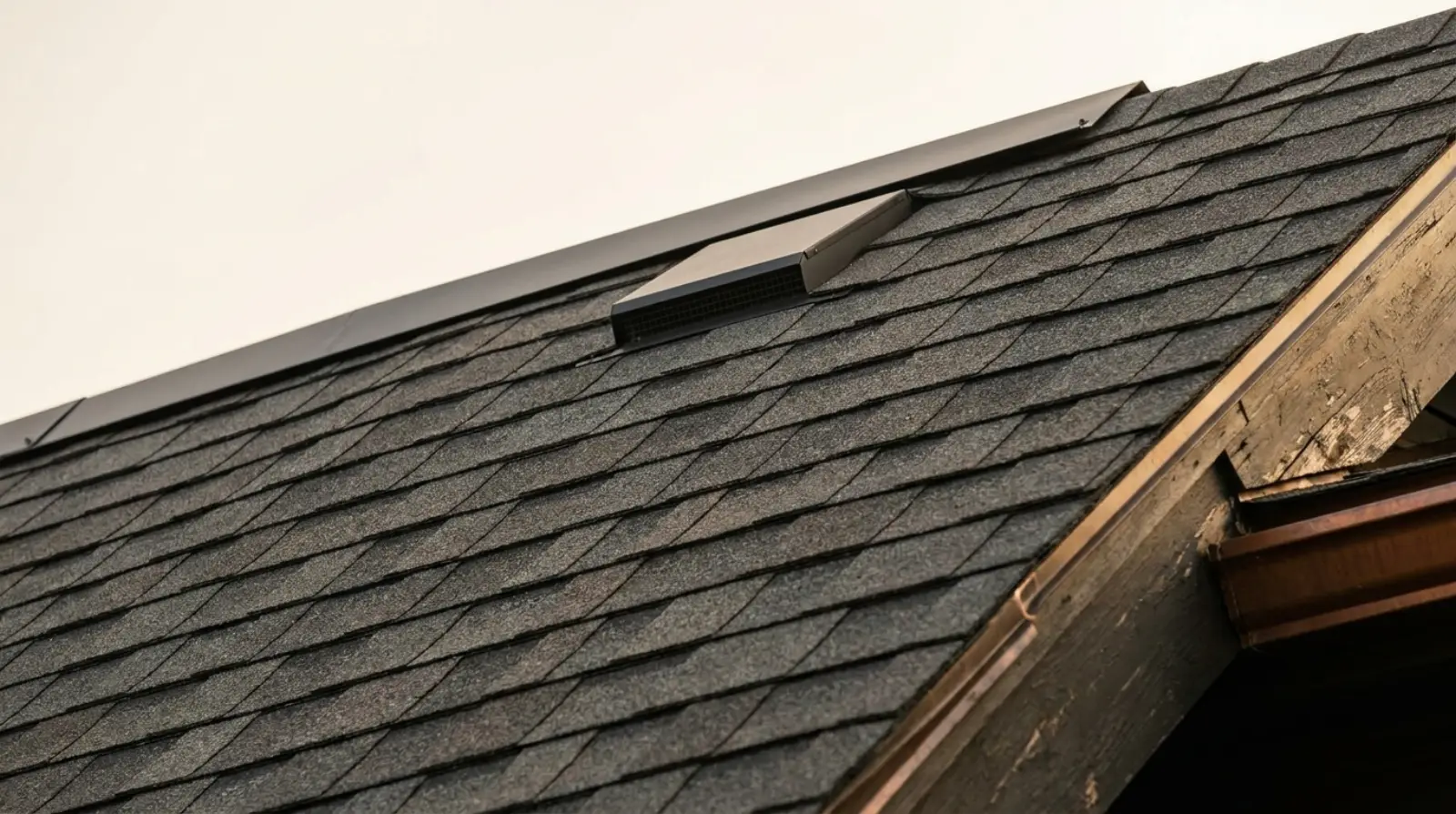
Exhaust at the ridge only works with matching intake at the soffits, and intake has to equal or exceed exhaust. Blown insulation pushed over the eave blocks it completely. Mixing a ridge vent with box vents or a powered fan is worse than either alone — air short-circuits between the two openings, the lower attic stops venting, and the upper vent starts pulling weather in. Inadequate ventilation on its own can cut a lifetime shingle warranty to ten years.
Every one of those is a repair. None of them means you need a new roof. A contractor who looks at any of them and quotes a full replacement without explaining why the field is finished is worth a second opinion.
How we decide, and how you can check the answer.
| What we find | Points to repair | Points to replacement |
|---|---|---|
| Granules | Shedding only near the problem | Washing out across every slope |
| Shingle condition | Flat, flexible, sealed | Curling, brittle, cracking underfoot |
| Where the water gets in | A detail — flashing, boot, valley | Multiple unrelated points at once |
| Deck | Solid, holds a nail | Soft or delaminated in places |
| Roof age | Well inside its service life | At or past it, with storm history |
If it lands in the middle, we say so rather than rounding up. A roof with years left does not need replacing because someone knocked on the door after a storm.
Roof repair questions we get asked.
It depends entirely on whether the field is sound. If the shingles across the roof still have their granules and lie flat, and the problem is a flashing detail or a pipe boot, a repair is the correct answer and it will last. If granules are washing out everywhere and the shingles are curling on every slope, a repair buys months and you will pay for the work twice. We will tell you which of those you have, in writing.
Active leaks come first. If water is coming in now, call rather than fill in the form — we answer during working hours and pick up storm calls after them. If it is dry and you want it looked at before the next storm, that is normally a matter of days.
No. Little Rock exempted residential roofs from the work-permit requirement in Ordinance 22,204, effective January 2023, and carried the exemption forward for 2026. That removes the city inspection, not the Arkansas Fire Prevention Code — the code still applies in full, there is just nobody checking. It is a reason to care who goes up there, not a reason to relax.
Often not, and we will say so. A repair that costs less than your deductible is not a claim, it is just a bill — and in Arkansas that matters more than it used to, because Bulletin 17-2023 allows insurers to apply a mandatory wind and hail deductible separate from your all-perils one. Claiming a small repair can cost you more than paying for it.
Almost always workmanship at a detail, not a defective shingle. The three we find most often are nails driven above the manufacturer's nail zone so they catch one laminate layer instead of two, a missing kick-out flashing where a roof meets a wall, and starter strip left off the rakes. All three are invisible from the ground and all three fail early.
Tell us where it leaks.
A description is enough to start. If it is a leak, say roughly where it shows up inside — that narrows it down faster than a photo does.